

1. About the Customer
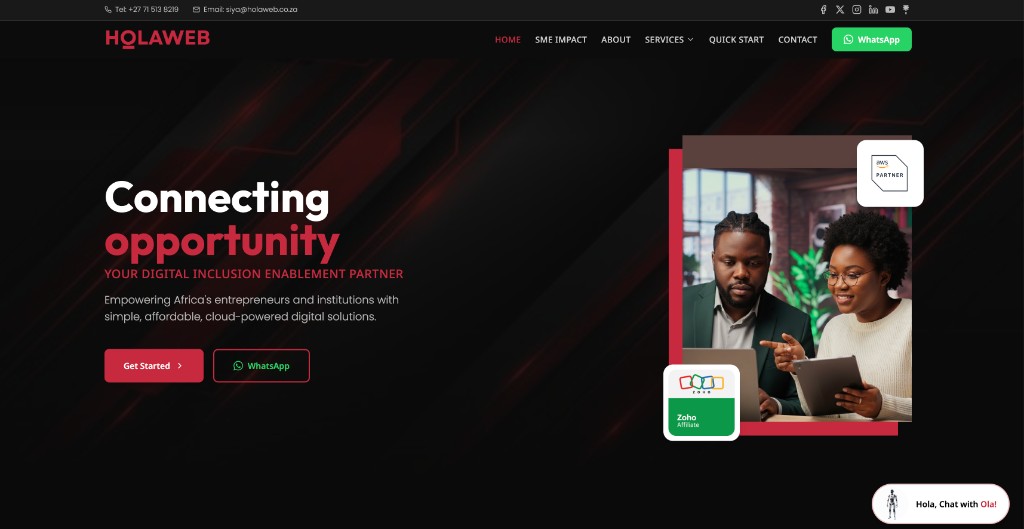
Holaweb Media Group is a South African digital solutions company positioned as a "Digital Inclusion Enablement Partner", helping entrepreneurs and institutions, from township businesses to enterprises, access simple, affordable, cloud-powered technology.
Based in Fourways, Gauteng, Holaweb is an AWS Partner and a Zoho Affiliate. Its multidisciplinary team combines product strategy, software engineering, design, data, and change management to help SMEs, enterprises, and public-sector entities modernise their citizen and customer experiences.
Holaweb's own offering spans cloud services (architecture, hosting, cost optimisation, and disaster recovery), web and app development, WhatsApp and payment integrations, and its own SME Impact Platform, a cloud-based tool that helps enterprises and development agencies manage, track, and scale supplier development and SME enablement programmes in support of Sustainable Development Goal 8: Decent Work and Economic Growth.
As a growing digital solutions company running multiple concurrent client engagements, sales conversations, and delivery workstreams, Holaweb needed a stronger internal operating platform to manage its own sales pipeline and project delivery, alongside the cloud and digital products it builds for its own customers.
2. Key Business Challenge
Holaweb's core challenge was keeping track of its own CRM pipeline in one place. The team came in as regular users of Pipedrive, but needed a solution that would let them view all of their CRM leads together rather than working from a single, flat pipeline view.
An initial requirement was the ability to segregate leads into categories, so that different categories of leads could be tracked together and Holaweb could develop a pipeline summary per category. Within each category, the team needed to immediately see the pipeline value, edit the pipeline stages to suit how Holaweb actually sells and delivers, and move leads along the pipeline as conversations progressed.
A second pain point sat outside the CRM entirely. Holaweb needed an agile project management tool that could support its delivery teams' scrum meetings, task assignment, and sprint tracking, rather than coordinating delivery work through disconnected chats, spreadsheets, and verbal updates.
Without a consolidated solution, Holaweb risked losing visibility of leads across categories, being unable to quickly answer basic questions such as the total pipeline value for a given category or service line, and running delivery work without the structure needed to plan, assign, and track tasks through regular sprint cadences.
3. Goals and Objectives
The primary goal of the engagement was to give Holaweb a single operating platform for its own sales pipeline and project delivery, replacing a single-view CRM tool and ad hoc delivery tracking with structured, categorised workflows.
Holaweb's business objectives were to:
- Consolidate CRM leads into one platform, replacing the fragmented view previously experienced in Pipedrive.
- Segregate leads into defined categories, so that different types of opportunities could be tracked and reported on together.
- Produce a pipeline summary per category, including the total pipeline value at a glance.
- Configure pipeline stages that reflect how Holaweb actually sells and delivers, rather than a generic default pipeline.
- Move leads through the pipeline as conversations and opportunities progress, with a clear view of where each lead stands.
- Introduce an agile project management capability that supports scrum meetings, sprint planning, and task assignment for delivery teams.
The technical objectives were to:
- Provide secure, browser-based access to the CRM and project management tools from one platform.
- Support multiple, independently configurable pipelines or pipeline views by lead category.
- Surface pipeline value and stage summaries per category without manual exporting or filtering.
- Provide a structured board for tasks, sprints, and team assignments to support agile delivery ceremonies.
- Apply role-based access across sales and delivery team members.
- Provide a production-grade AWS environment capable of scaling as Holaweb's own client base grows.
4. Designation Definition Fit
This customer reference aligns with the AWS Small and Medium Business Competency within the SaaS Solutions category.
Holaweb is itself an SMB and AWS Partner that required an affordable, configurable SaaS platform to run its own internal sales and delivery operations, rather than continuing to combine a standalone CRM tool with informal project tracking.
The Skhokho implementation supports business functions that fall within the scope of SMB-focused SaaS solutions, including:
- Customer relationship management and multi-category pipeline configuration.
- Sales opportunity and pipeline-value reporting.
- Project and task management.
- Agile sprint and team collaboration workflows.
- Role-based information access.
The engagement made direct use of Skhokho's CRM and Sales Pipeline Management, described on the Skhokho platform (https://skhokho.ai) as customer relationship management with lead tracking and conversion optimisation, alongside Skhokho's Project Management and Team Collaboration functionality, which supports planning tasks, tracking milestones, and managing teams through collaborative workflows.
For Holaweb, this meant replacing a single Pipedrive view with category-specific CRM pipelines, each with its own configurable stages and an immediately visible pipeline value, while delivery teams adopted Skhokho's project boards to run scrum meetings, assign tasks, and track sprints.
The solution is a strong fit for the designation because it demonstrates how an AWS-hosted SaaS platform can give a growing SMB and AWS Partner a single, categorised view of its sales pipeline alongside structured agile delivery tracking, without requiring Holaweb to operate several disconnected point solutions.
5. Technical Solution
Tati Software implemented SkhokhoAI as Holaweb's central platform for CRM pipeline management and agile project delivery.
SkhokhoAI is a multi-functional SaaS platform that integrates CRM, project management, document management, financial administration, and collaboration within a single application.
The Holaweb implementation focused on:
- Multiple CRM pipelines configured by lead category.
- Customisable pipeline stages per category.
- Pipeline-value summaries visible per category.
- Lead movement and stage transitions tracked within the CRM.
- Project boards configured to support sprints, task assignment, and scrum-style delivery tracking.
- Role-based access across sales and delivery team members.
Architecture Diagram Reference
Users access the SkhokhoAI platform through the public application domain. Amazon Route 53 provides DNS resolution for the application domain, and Amazon CloudFront provides content delivery and caching for static application content.
Application requests are routed through an Application Load Balancer to containerised application services running on Amazon Elastic Container Service with AWS Fargate.
The SkhokhoAI web application and API are implemented using Python and Django. The application layer handles user authentication, organisation and role separation, CRM pipeline and category configuration, project board and sprint processing, and reporting.
PostgreSQL provides the relational data layer for organisations, users, roles and permissions, leads, pipeline categories, pipeline stages, projects, tasks, sprints, and configuration information.
Redis provides a high-performance caching and temporary data layer, used for application caching, session support, and background task coordination.
Amazon S3 stores attachments, exported reports, and other unstructured content associated with CRM and project records.
The application runs within an Amazon Virtual Private Cloud. Public and private subnets separate internet-facing services from application and data components. AWS Identity and Access Management controls permissions between AWS services and administrative users, and security groups restrict traffic between the load balancer, application services, database layer, cache layer, and other infrastructure components.
Amazon CloudWatch provides centralised application logs, infrastructure metrics, health monitoring, and operational visibility.
Amazon Route 53
Amazon Route 53 was selected to provide DNS resolution for the production application domain, integrating directly with AWS services and keeping DNS administration within the same AWS environment as the production workload.
Amazon CloudFront
Amazon CloudFront was selected to deliver static content and cache frequently requested application resources, reducing repeated requests to the application origin and providing consistent HTTPS delivery.
Amazon S3
Amazon S3 was selected to store CRM attachments, exported pipeline reports, and project-related documents. Amazon S3 provides scalable object storage without requiring Tati Software or Holaweb to provision file servers.
Storing uploaded files directly on application containers was rejected because ECS tasks can be replaced during deployments, scaling events, or infrastructure recovery.
Amazon ECS with AWS Fargate
Amazon ECS with AWS Fargate was selected to run the containerised Django application and API services. Fargate removes the requirement to provision, patch, and maintain container host instances, reducing infrastructure administration for the workload.
Application Load Balancer
The Application Load Balancer distributes incoming HTTPS requests across healthy ECS tasks, providing health checks, TLS termination, and controlled access to the application containers.
Amazon VPC
Amazon VPC provides network isolation for the production environment. Internet-facing components are separated from application and data components through public and private subnets.
NAT Gateway
A NAT Gateway enables workloads in private subnets to access approved internet services without allowing unsolicited inbound connections, keeping application containers inaccessible directly from the public internet.
S3 Gateway VPC Endpoint
An S3 Gateway VPC Endpoint enables workloads within the VPC to communicate with Amazon S3 without routing that traffic through the public internet or NAT Gateway, reducing cost and providing a more direct route to stored content.
PostgreSQL
PostgreSQL was selected because CRM, pipeline, project, and sprint information is highly relational, requiring transactional consistency between leads, categories, pipeline stages, projects, tasks, and sprints.
Redis
Redis was selected to provide caching, session support, and background task coordination, reducing repeated reads against the relational database and improving responsiveness when loading pipeline dashboards and project boards.
Amazon CloudWatch
Amazon CloudWatch provides centralised logging and monitoring for the application and its supporting infrastructure, allowing operational issues to be identified without depending on logs stored on individual, replaceable containers.
AWS Identity and Access Management
AWS Identity and Access Management provides controlled access to AWS resources, with IAM roles assigned to application workloads and administrators according to the principle of least privilege.
Integration Between Components
The major integration flow is as follows:
- A sales or delivery team member accesses the SkhokhoAI application through a supported web browser.
- Amazon Route 53 resolves the application domain.
- Amazon CloudFront serves cached application content and forwards relevant requests to the application origin.
- The Application Load Balancer routes traffic to healthy ECS Fargate tasks.
- The Django application authenticates the user and determines their role and permitted functions.
- A new lead is captured and assigned to the relevant pipeline category, with its stage tracked within PostgreSQL.
- Redis supports session and caching requirements while pipeline dashboards and project boards are in use.
- Pipeline-value summaries are calculated per category and displayed on the CRM dashboard.
- Delivery teams create projects, tasks, and sprints within the configured project boards.
- Task assignments and sprint progress are recorded and updated as work moves forward.
- Attachments and exported reports are stored in Amazon S3.
- Application logs and operational metrics are sent to Amazon CloudWatch.
6. Solution Optimality
Several approaches were considered before SkhokhoAI's CRM and Project Management functionality was selected.
Continued Use of Pipedrive Alone
Holaweb could have continued using Pipedrive as a standalone CRM tool.
This approach was rejected because Pipedrive did not give the team a way to segregate leads into categories with independent pipeline summaries, and it did not address the separate need for agile project management.
Separate CRM and Project Management Products
Holaweb could have kept a CRM tool and added a separate, dedicated project management product such as a generic task board.
This option was rejected because it would have required two subscriptions, two logins, and no shared context between a sales opportunity and the delivery work it eventually generates.
Generic Spreadsheet-Based Tracking
Pipeline categories and project tasks could have been tracked through shared spreadsheets.
This was rejected because spreadsheets do not enforce pipeline stages, do not automatically calculate pipeline value per category, and do not support real-time collaboration during scrum meetings.
Custom-Built Internal Tool
Holaweb, as a software company itself, could have built a fully custom internal CRM and project management tool.
This approach was rejected because the development time and ongoing maintenance burden would have diverted engineering capacity away from Holaweb's own client-facing products, to build functionality that already existed within an available SaaS platform.
Selected Approach
SkhokhoAI was selected because it provided categorised CRM pipelines with configurable stages and visible pipeline value, alongside agile project boards for sprints and task assignment, within one platform.
Holaweb received:
- Multiple CRM pipelines segmented by lead category.
- Configurable pipeline stages matching its own sales process.
- Pipeline-value summaries per category.
- Agile project boards supporting scrum meetings, sprints, and task assignment.
- Role-based access for sales and delivery teams.
- A secure, scalable AWS-hosted environment.
This approach maximised the practical value of the platform while limiting cost, administrative complexity, and the number of separate systems Holaweb needed to operate.
9. Key Performance Indicators
The following KPIs summarise the measurable improvements associated with the engagement. Final values should be validated and approved by Holaweb before any formal competency submission.
| # | KPI | Baseline (Before) | Target | Actual Result (After) | Improvement |
|---|---|---|---|---|---|
| 1 | Systems used to manage the sales pipeline | 2 (Pipedrive plus manual spreadsheet exports for reporting) | 1 unified platform | 1 (SkhokhoAI) | -50% |
| 2 | Leads assigned to a defined pipeline category | 0% (single flat pipeline) | 100% | 100% of leads captured through the configured CRM | +100 percentage points |
| 3 | Time to view total pipeline value for a category | ~15-20 minutes (manual export and filtering) | Near-instant | Under 1 minute via the category dashboard | -95% |
| 4 | Active projects tracked through a structured agile board | 0% (ad hoc tracking via chat and spreadsheets) | 100% | 100% of active delivery projects | +100 percentage points |
Measurement methodology
Baseline values were established from Holaweb's description of its previous Pipedrive-based and ad hoc delivery-tracking processes. Actual results were measured by reviewing the configured CRM categories and pipeline dashboards, and by confirming that active delivery projects are tracked through the configured project boards.
10. Continuous Improvement
Migrating Pipeline Data from Pipedrive
Moving existing leads and deals out of Pipedrive required mapping each lead to an appropriate category and pipeline stage within SkhokhoAI, rather than a direct one-to-one field copy.
Future implementations will include a short mapping exercise between the source CRM's stages and the categories and stages being configured in Skhokho, so that historical pipeline data is not lost or misclassified during migration.
Defining Lead Categories and Pipeline Stages
Holaweb's initial category structure and pipeline stages were refined after the team began using the platform day to day, as some categories were merged and stage names were adjusted to match the language the sales team actually uses.
This reinforced the value of treating the category and pipeline structure as a living configuration, reviewed periodically rather than finalised once at go-live.
Embedding Agile Ceremonies in the Project Boards
Introducing scrum meetings, sprint planning, and task assignment through the new project boards required the delivery team to adjust from informal, chat-based coordination to a structured board-based workflow.
The team adopted the boards progressively, starting with task assignment and sprint tracking before layering in full sprint planning and retrospective practices.
Role-Based Access Across Sales and Delivery Teams
Configuring appropriate access for sales team members, delivery team members, and management ensured that each group could see the pipeline and project information relevant to their role without unnecessary duplication of access.
Ongoing Customer Support
Tati Software continues to support Holaweb after onboarding through periodic check-ins, used to review CRM and project-board adoption, refine pipeline categories, and identify further internal processes that could be simplified within Skhokho.
Let's build your success story.
Talk to us about how we can help your business grow with technology.