

1. About the Customer
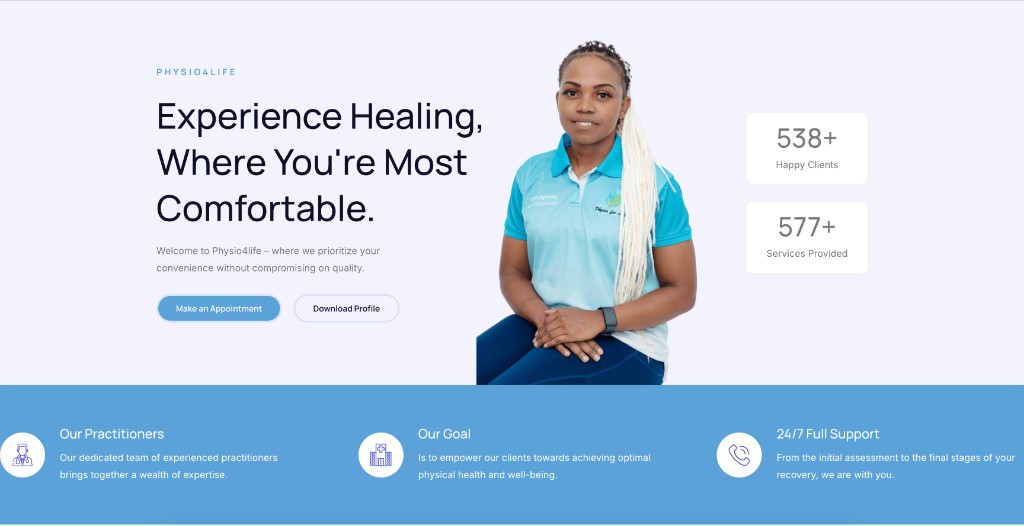
Physio4Life is the trading name of Diana Kgokong Physiotherapy, a South African physiotherapy practice based in Helderkruin, Johannesburg.
The practice is registered with the Health Professions Council of South Africa (HPCSA), the South African Society of Physiotherapy (SASP), and the Board of Healthcare Funders (BHF), and delivers care through a patient-centred, holistic, and evidence-based approach.
Physio4Life differentiates itself through a mobile, client-first service model. Rather than requiring clients to travel to a clinic, the practice brings physiotherapy directly to the client's home, and supplements in-person consultations with telehealth appointments. Services include detailed assessment and treatment, manual mobilisation, pre- and post-operative care, movement and postural correction, and core activation and exercise prescription.
Physio4Life operates within the small business and self-employed practitioner segment. As the practice's client base grew, so did the volume of consultation notes, treatment records, and client documentation that needed to be captured, organised, and retrieved accurately and quickly.
Because the practice's service quality depends on accurate, accessible consultation history for every client, Diana Kgokong Physiotherapy required a digital platform that could replace manual, paper-based note-taking with a structured, searchable, and secure system.
2. Key Business Challenge
Before adopting Skhokho, Physio4Life managed its consultation notes using physical files. Notes were handwritten during or after each session and, in some cases, scanned at a later stage for safekeeping.
This manual process created fragmented data. Notes for the same client existed across handwritten pages, scanned images, and occasionally separate digital files, with no consistent structure linking them together.
This became a practical problem during consultations. When a client returned for a follow-up session, it was often difficult to quickly locate their previous notes, treatment history, or progress records at the point of care, which is precisely when that information is most needed.
There was also no consistent format for how notes were captured. Each consultation note had to be structured from scratch, which took time away from client care and led to inconsistent record-keeping across sessions and clients.
The practice needed a note-taking platform that could:
- Organise consultation notes into client-specific folders.
- Structure notes by date, so that a client's treatment history could be reviewed chronologically.
- Make notes fast and easy to find, including during an active consultation.
- Support templating, so that a consistent note structure did not need to be rebuilt for every session.
- Keep client records in a clean, unified format rather than split across paper, scans, and disconnected files.
Without a solution, the risks included slower consultations while searching for historical notes, inconsistent documentation quality, the potential loss or damage of physical files, and a growing administrative burden as the client base expanded.
3. Goals and Objectives
The primary goal of the engagement was to give Physio4Life a single, organised, and secure home for every client's consultation notes and records, replacing paper-based files with a structured digital workflow.
The practice's business objectives were to:
- Run a better organised practice, with consultation notes and client records structured consistently across every client and session.
- Establish a single source of truth for client information, accessible from one place rather than scattered across physical files, scans, and ad hoc documents.
- Improve the sharing of information between the practice's assistant receptionist and the physio herself, so that both could work from the same up-to-date client record without duplicating or misplacing information.
- Prepare the practice for future audit and accounting processes, by keeping client and administrative records in a consistent, retrievable digital format rather than dispersed paper documentation.
- Reduce the time spent searching for a client's notes and history during or between consultations.
- Remove the need to rebuild a note's structure from scratch for every session.
The technical objectives were to:
- Provide secure, browser-based access to client notes and records.
- Organise notes and documents into a structured workspace linked to each client's profile.
- Support reusable note templates for recurring consultation types.
- Apply role-based access so that the receptionist and the physio could each access the information relevant to their role.
- Provide a production-grade, secure AWS environment suitable for storing client health-related documentation.
- Reduce the practice's reliance on physical filing and manual scanning.
4. Designation Definition Fit
This customer reference aligns with the AWS Small and Medium Business Competency within the SaaS Solutions category.
Physio4Life is a small, self-employed healthcare practice that required an affordable, easy-to-use SaaS platform capable of replacing manual, paper-based administration, without the cost or complexity of a dedicated practice-management or electronic medical record system.
The Skhokho implementation supports several business functions that fall within the scope of SMB-focused SaaS solutions, including:
- Document and note management.
- Structured client record-keeping.
- Team collaboration between the physio and administrative staff.
- Role-based information access.
- Client and contact management.
- Financial administration and invoicing.
The engagement made direct use of Skhokho Workspaces and SkhokhoAI Notes, described on the Skhokho platform (https://skhokho.ai) as bringing documents, notes, and tables together into shared or personal folders, with AI-assisted notes, blocks, and helpers that speed up writing and organisation.
For Physio4Life, each client profile now has its own workspace, within which consultation notes are organised by date and can be created from a reusable template rather than being restructured for every session. This directly replaced the practice's previous reliance on physical files and scanned documents.
This is consistent with feedback the practice has shared publicly about its use of Skhokho, noting: "Skhokho has taken a huge weight off my shoulders regarding the daily running of my practice. Particularly, with managing my client information and generating invoices."
The solution is a strong fit for the designation because it demonstrates how an AWS-hosted SaaS platform can give a small, self-employed healthcare practitioner enterprise-grade document organisation and record-keeping, without requiring the practice to build, host, or maintain its own software or infrastructure.
5. Technical Solution
Tati Software implemented SkhokhoAI as Physio4Life's central platform for client records and consultation note management.
SkhokhoAI is a multi-functional SaaS platform that integrates Workspaces, AI-assisted Notes, document management, CRM, and financial administration within a single application.
The Physio4Life implementation focused on:
- A dedicated workspace linked to each client's profile.
- Consultation notes organised into client folders, structured by date.
- Reusable note templates for recurring consultation types.
- Centralised, searchable client documentation.
- Role-based access for the physio and the assistant receptionist.
- Invoicing linked to client records.
Architecture Diagram Reference
Users access the SkhokhoAI platform through the public application domain. Amazon Route 53 provides DNS resolution for the application domain, and Amazon CloudFront provides content delivery and caching for static application content.
Application requests are routed through an Application Load Balancer to containerised application services running on Amazon Elastic Container Service with AWS Fargate.
The SkhokhoAI web application and API are implemented using Python and Django. The application layer handles user authentication, organisation and role separation, workspace and folder structures, note templating, document metadata, and client-record processing.
PostgreSQL provides the relational data layer for organisations, users, roles and permissions, client and contact records, workspace and folder structures, note metadata, templates, invoices, and configuration information.
Redis provides a high-performance caching and temporary data layer, used for application caching, session support, and background task coordination.
Amazon S3 stores uploaded scans, notes, attachments, and other unstructured client documentation.
The application runs within an Amazon Virtual Private Cloud. Public and private subnets separate internet-facing services from application and data components. AWS Identity and Access Management controls permissions between AWS services and administrative users, and security groups restrict traffic between the load balancer, application services, database layer, cache layer, and other infrastructure components.
Amazon CloudWatch provides centralised application logs, infrastructure metrics, health monitoring, and operational visibility.
Amazon Route 53
Amazon Route 53 was selected to provide DNS resolution for the production application domain, integrating directly with AWS services and keeping DNS administration within the same AWS environment as the production workload.
Amazon CloudFront
Amazon CloudFront was selected to deliver static content and cache frequently requested application resources, reducing repeated requests to the application origin and providing consistent HTTPS delivery.
Amazon S3
Amazon S3 was selected to store scanned documents, note attachments, and client files. The volume of this content can grow independently from the application workload, and Amazon S3 provides scalable object storage without requiring Tati Software or the practice to provision file servers.
Storing uploaded documents directly on application containers was rejected because ECS tasks can be replaced during deployments, scaling events, or infrastructure recovery.
Amazon ECS with AWS Fargate
Amazon ECS with AWS Fargate was selected to run the containerised Django application and API services. Fargate removes the requirement to provision, patch, and maintain container host instances, reducing infrastructure administration for a small-practice workload of this size.
Application Load Balancer
The Application Load Balancer distributes incoming HTTPS requests across healthy ECS tasks, providing health checks, TLS termination, and controlled access to the application containers.
Amazon VPC
Amazon VPC provides network isolation for the production environment. Internet-facing components are separated from application and data components through public and private subnets, so that client documentation and notes remain within restricted network segments.
NAT Gateway
A NAT Gateway enables workloads in private subnets to access approved internet services without allowing unsolicited inbound connections, keeping application containers inaccessible directly from the public internet.
S3 Gateway VPC Endpoint
An S3 Gateway VPC Endpoint enables workloads within the VPC to communicate with Amazon S3 without routing that traffic through the public internet or NAT Gateway, reducing cost and providing a more direct route to stored documents.
PostgreSQL
PostgreSQL was selected because client, workspace, note, and invoicing information is highly relational, requiring transactional consistency between client profiles, folders, notes, templates, and financial records.
Redis
Redis was selected to provide caching, session support, and background task coordination, reducing repeated reads against the relational database and improving responsiveness when opening a client's workspace.
Amazon CloudWatch
Amazon CloudWatch provides centralised logging and monitoring for the application and its supporting infrastructure, allowing operational issues to be identified without depending on logs stored on individual, replaceable containers.
AWS Identity and Access Management
AWS Identity and Access Management provides controlled access to AWS resources, with IAM roles assigned to application workloads and administrators according to the principle of least privilege.
Integration Between Components
The major integration flow is as follows:
- The physio or receptionist accesses the SkhokhoAI application through a supported web browser.
- Amazon Route 53 resolves the application domain.
- Amazon CloudFront serves cached application content and forwards relevant requests to the application origin.
- The Application Load Balancer routes traffic to healthy ECS Fargate tasks.
- The Django application authenticates the user and determines their role and permitted functions.
- The user opens a client's profile, which loads that client's dedicated workspace.
- Consultation notes are created from a saved template or a blank note, and are organised by client folder and date within PostgreSQL.
- Redis supports session and caching requirements while the workspace is in use.
- Scanned documents and attachments are stored in Amazon S3, with metadata and folder relationships stored in PostgreSQL.
- Notes and documents can be searched and retrieved directly from the client's workspace during a consultation.
- Invoices linked to the client record can be generated from within the same platform.
- Application logs and operational metrics are sent to Amazon CloudWatch.
6. Solution Optimality
Several approaches were considered before SkhokhoAI's Workspaces and Notes functionality was selected.
Continued Paper-Based Filing
The practice could have continued using physical files, with periodic scanning for backup.
This approach was rejected because it was the source of the original problem: fragmented records, slow retrieval during consultations, and no consistent note structure.
Generic Note-Taking Applications
General-purpose note-taking or document tools could have been used to digitise consultation notes.
This option was rejected because these tools are not linked to a structured client or workspace model, would not provide client-specific folders alongside invoicing and contact information, and would still require the practice to manage a separate system for financial administration.
Standalone Practice-Management or EMR Software
A dedicated, healthcare-specific practice-management or electronic medical record product could have been implemented.
This was not selected because it would have introduced a separate subscription and login purely for notes and scheduling, disconnected from the client and invoicing information the practice also needed to manage day to day.
Custom-Built Records System
A fully custom notes and client-records application could have been developed specifically for the practice.
This approach was rejected because the cost, development time, and ongoing maintenance obligations would have been disproportionate for a single-practitioner business.
Selected Approach
SkhokhoAI was selected because Skhokho Workspaces and SkhokhoAI Notes provided client-linked, template-driven note-taking alongside document storage, contact management, and invoicing, within one platform.
The practice received:
- A dedicated workspace per client profile.
- Notes organised by client and date.
- Reusable note templates.
- Centralised, searchable documentation.
- Role-based access for the physio and receptionist.
- Invoicing linked to the same client record.
- A secure, scalable AWS-hosted environment.
This approach maximised the practical value of the platform while limiting cost, administrative complexity, and the number of separate systems the practice needed to operate.
9. Key Performance Indicators
The following KPIs summarise the measurable improvements associated with the engagement. Final values should be validated and approved by the practice before any formal competency submission.
| # | KPI | Baseline (Before) | Target | Actual Result (After) | Improvement |
|---|---|---|---|---|---|
| 1 | Consultation note retrieval time | 5-8 minutes (physical files) | Near-instant | Under 30 seconds | -90% |
| 2 | Consultation notes created from a standard template | 0% | Majority of recurring consultation types | 80-90% of applicable sessions | +80-90 percentage points |
| 3 | Separate record-keeping formats used for new consultations | 3 formats (paper, scans, ad hoc digital) | 1 format | 1 (Skhokho workspace) | -67% |
Measurement methodology
Baseline values were estimated from the practice's description of its previous manual filing process. Actual results were measured by timing note retrieval within the configured workspace, reviewing template adoption across consultation types, and confirming that new consultations are recorded exclusively within the workspace.
10. Continuous Improvement
Role-Based Access Between Physio and Reception
An early consideration in the implementation was ensuring that the assistant receptionist and the physio each had access appropriate to their role, so that administrative tasks such as scheduling and invoicing could be handled by reception while clinical notes remained managed by the physio.
This was addressed by configuring role-based access within the practice's Skhokho organisation, so that both team members work from the same client record without unnecessary duplication of access.
Migration of Historical Records
Some client history existed only in physical or scanned form prior to implementation. Rather than migrating the full historical archive at once, the practice prioritised moving active clients into the new workspace structure first, with older records digitised progressively.
Future guidance for similar practices will include a lightweight, phased digitisation plan so that historical paper records do not become a barrier to adopting a digital workspace.
Note Template Refinement
The initial note templates were refined after the first few weeks of use, based on which fields and structures were actually useful during real consultations.
This reinforced the value of treating templates as a living structure that is reviewed and adjusted periodically, rather than finalised once and left unchanged.
Preparing for Audit and Accounting Readiness
Keeping client and administrative records in a single, consistent digital format also supports the practice's future audit and accounting requirements, since information does not need to be reconstructed from paper files if it is requested for review.
This objective will continue to inform how new record types and templates are structured going forward, so that the practice's documentation remains consistent and retrievable over time.
Ongoing Customer Support
Tati Software continues to support Physio4Life after onboarding through periodic check-ins, used to review workspace adoption, refine templates, and identify further administrative processes that could be simplified within Skhokho.
Let's build your success story.
Talk to us about how we can help your business grow with technology.